
Media Concept Project, Breda University of Applied Sciences
A platform concept designed to give fan communities a dedicated space to collaboratively analyze, map, and preserve interpretations of complex media narratives.
Summary
Narralis is a platform concept for collaborative narrative analysis, designed to give fan communities a dedicated space to build and share structured interpretations of complex media. Instead of scattering theories, timelines, and discussions across Reddit threads, Discord servers, and YouTube comments, Narralis brings that process into one connected environment built specifically for it.
Challenge & Role
Online fan communities generate huge amounts of analysis and interpretation, but the tools they use weren’t built for it. Discussion platforms support conversation but not structure; wikis hold information but not discussion; video essays analyse but don’t connect to the wider conversation. The result is knowledge that’s scattered and hard to piece together, especially for newcomers. As the sole designer and researcher on this project, I identified this gap, researched its underlying causes, and designed a platform concept to address it from the ground up, including its core features, interface, and business model.
Key Factors
- Identified a genuine, underserved gap in how online communities organize and preserve complex narrative discussion
- Designed a timeline-based system as the platform’s core feature, letting users map and compare interpretations visually rather than through linear threads
- Built a spoiler-management system that filters content by each user’s personal progress, solving a real and common frustration in fan communities
- Designed an ethical monetisation model using purely cosmetic purchases, keeping full platform functionality free for all users
- Grounded every major design decision in established UX and cognitive theory (progressive disclosure, cognitive load theory, participatory culture)
Solution & Outcome
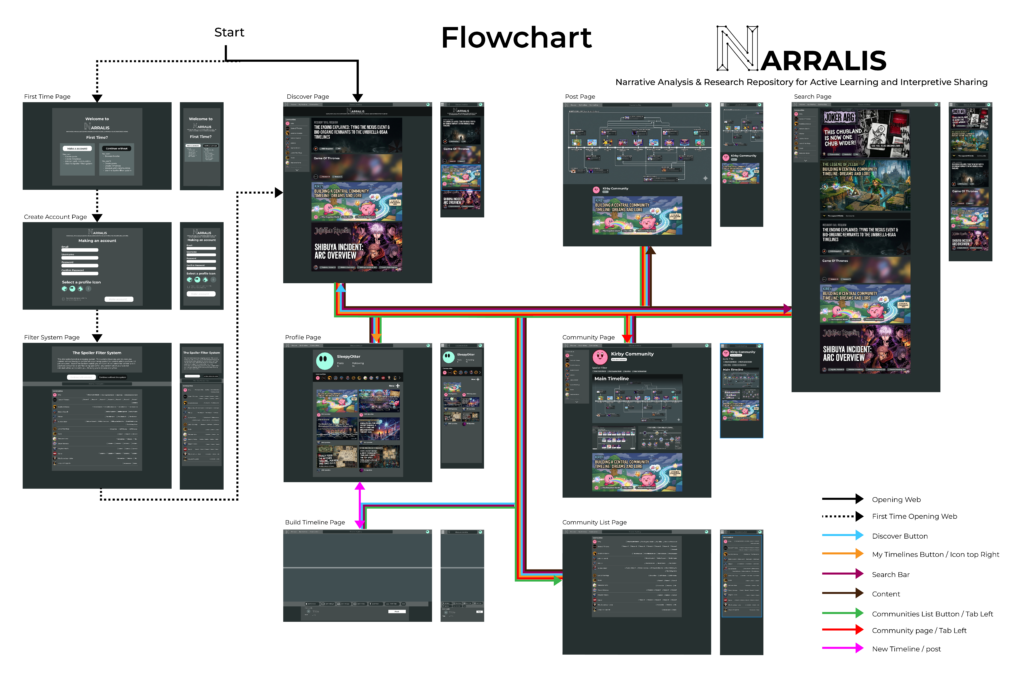
At the core of Narralis is its timeline system: a visual, node-based way of mapping a narrative’s events, theories, and interpretations, where users can build competing or alternative timelines for the same story rather than being forced into a single “correct” version. This turns analysis into something spatial and collaborative, rather than a long scrolling thread.
To solve the common problem of spoilers in fan spaces, I designed a dynamic spoiler management system. Content is tagged with metadata about which part of a story it relates to, and users set their own exposure level, so spoiler-sensitive content is automatically blurred or hidden based on how far along they are, rather than relying on manual warnings.
Each community within the platform centres on a specific show, game, or franchise, with a “Main Timeline” that the community collectively votes into place as its leading interpretation, while alternative theories stay visible rather than being buried, preserving space for differing viewpoints.
To keep the platform accessible, I designed a freemium model built entirely around optional cosmetic customisation (profile themes, icons, identity markers) rather than paywalling any functional feature, so financial means never affects a user’s ability to participate or be heard.
I also designed the onboarding flow, homepage structure, and a set of gender-neutral default user icons, and tested the site’s navigation flow with users to confirm the structure felt intuitive.
The result is a fully designed platform concept, from product strategy through to interface and visual design, built on real research into fan behaviour and backed by established design and cognitive theory.
Tools & Skills Used
UX research ✦ Information architecture ✦ UI design ✦ Prototyping ✦ Photoshop ✦ Illustrator ✦ Business/monetization strategy

